
Joy = Safety + Belonging
Even when the world feels frightening, joy is how we restore our power and our humanity. My signature framework, grounded in neuroscience and 28+ years of medicine, gives your people tools they’ll actually use and gives your organization a culture that lasts.
Watch my TEDx talk: what happened when I learned to thank my pain.

My Signature Framework
Trusted by


















KEYNOTES
-
Today’s survivorship care too often stops at screening schedules, a nutrition handout, and a counseling referral. What it misses is the trauma: of diagnosis, of treatment, and of the healthcare experience itself. Drawing on 28+ years as an integrative physician and her own life as a breast cancer thriver, Dr. Sethi makes the case for a new model, one that treats survivorship as the start of healthspan, not the end of treatment, and gives survivors what they actually need to thrive.
Ideal for cancer centers, oncology and survivorship conferences, health systems, and patient advocacy organizations.
-
Patients are managing more of their health on their own than ever, through supplements, home labs, wearables, and AI, and most aren’t telling their doctors. The problem isn’t that patients have too much information. It’s that the system hasn’t earned their trust. Drawing on 28+ years as a physician and educator, and on her own experience as a cancer patient and mother of a child with a fatal illness, Dr. Sethi shows why efficiency without connection erodes trust, and how clinicians and organizations can use AI to become more human, not less. Because we can’t ask patients to trust us if we don’t trust them.
Ideal for health systems, medical conferences, and health-tech leaders.
-
Burnout isn’t a personal failure, and joy isn’t reserved for people who are “resilient enough.”
Drawing on her signature framework, Joy = Safety + Belonging, Dr. Sethi shows why Joy is different from happiness and toxic positivity, and why it’s one of our most powerful tools for preventing and healing burnout. Through story and accessible neuroscience, your group learns practical strategies that work even when life and the world feel unbearable, without pretending the hard things aren’t real or that broken systems don’t need to change.
Ideal for any group navigating burnout, uncertainty, or change, from health systems and corporate teams to conferences and community organizations.
-
Leaders who feel unseen can’t build cultures where others feel seen. Building on her framework, Joy = Safety + Belonging, Dr. Sethi shows leaders how reclaiming their own identity and sense of safety makes them more trusted, more effective, and better able to create teams where people belong and do their best work. Practical, honest, and grounded in neuroscience.
Ideal for executive teams, physician and nurse leaders, and leadership development programs.
-
When hard things happen, most of us ask “Why me?” This talk turns that question around. Drawing on mind-body medicine, neuroscience, and her own life, Dr. Sethi shows how this one shift changes the way we meet suffering, and opens a path back to Joy, for individuals and the communities they lead.
Ideal for any group facing loss, adversity, or upheaval, from patient and caregiver communities to organizations moving through hard seasons.
Workshops
Any keynote can be paired with an interactive workshop that turns ideas into action. Drawing on decades of clinical leadership, teaching, and group facilitation, I design sessions around your organization’s goals, from building a culture of well-being with practical, science-backed tools, to strengthening trust and connection between clinicians and patients, to redesigning programs like survivorship care around what people actually need. Let’s talk about what your team needs.

More speaking topics include:
-
The Power of Gratitude Medicine
Finding the Sacred in Everyday Life: Mindfulness, Ritual, and Food
Self-Compassion: How The Neuroscience of Love Can Help You Choose Healthy Habits
-
Becoming Whole in Broken Systems
Radicalizing Your Self-Care in an Unjust World
-
How to Build an Anti-racist Organization
Anti-racism 101: Decolonizing Your Care
Ask Better Questions: Becoming a True Ally
Implicit Bias is a Health Hazard
-
The Trauma No One Treats: Diagnosis, Treatment, and the Healthcare Experience
Healthspan After Cancer: What Survivors Actually Need
From Survivorship to Thrivorship: Building Better Programsem description
-
Feed Your Bugs Well: The Wondrous Microbiome and Its Role in Our Health
Digestive Health: A Mindful Approach
Your Belly Brain: The Microbiome’s Role in Mental Health
If Budget Is the Barrier: Food as Medicine in Underserved Populations
Food as Medicine for Brain Health
Healing Spices and Herbs: Transforming Your Pantry Into Your Medicine Cabinet
-
Beyond Hot Flashes: An Integrative Approach to Menopause
Hormones, Sleep, and Brain Fog: What Midlife Women Need to Know
Midlife as a Turning Point for Healthspan
-
Reciprocity is the First Step to Healing in Psychedelic Medicine
Plant Medicine 101: How It Works and Who It Doesn’t Work For
Psychedelic Medicine: Is It My Path to Healing Trauma?
Will Psychedelic Medicine Damage My Brain: Unraveling the Racism
Psychedelic Medicine in Group Settings: Why it Matters
Testimonials
-
![]()
“Dr. Sethi’s presentations are a thought-provoking combination of the power of personal growth and vulnerability. She engages her audience in such a manner that few will leave unchanged and most will emerge with new knowledge of themselves.”
― Renee Crichlow, MD, Vice-Chair of Health Equity BU Dept of Family Med, Lecturer Harvard T.H. Chan School of Public Health, President-Elect Society of Teachers of Family Medicine
-
![]()
“Dr. Sethi is a bright shining star. Intelligent, compassionate and driven,she is pushing the edges of medicine precisely in the direction it needs to go—towards complete mind and body health. Her ability to educate and inspire people to embrace food as medicine from a balanced and delicious approach empowers her students to be more directly connected to their health and the health of their loved ones. In advocating for finding gratitude in the face of life’s many challenges, Tanmeet’s teaching has inspired and improved the lives of countless others, including my own.”
―Becky Selengut, Chef, Instructor, and Author













Media & podcasts
Read a sampling of Tanmeet’s work
-
![]()
New York Times: Why It's Best To Imagine The Worst (Modern Love Column)
-
![]()
OPRAH DAILY FEATURE: Joy Is My Justice
-
![]()
Oprah Daily: What to Say When Someone You Love Is Hurting
-
![]()
Daily Mail: My child is dying and there's no way to change that, yet I've learnt to still feel joy amid the pain.
-
![]()
NPR "The Record": Bill Radke Interview on having gratitude for the hard things
-
![]()
Metro UK: My child is dying – but my life is still filled with joy
-
![]()
The Telegraph: Eight Instant ways to de-stress and all for free
-
![]()
NPR: "New Seattle doctors learn to prescribe food as medicine" (Tanmeet's Culinary Medicine Program)
-
![]()
Ms magazine: Joy Is My Justice chosen as a May 2023 Read
-
![]()
Authority Magazine Interview: Happiness and Joy During Turbulent Times
-
![]()
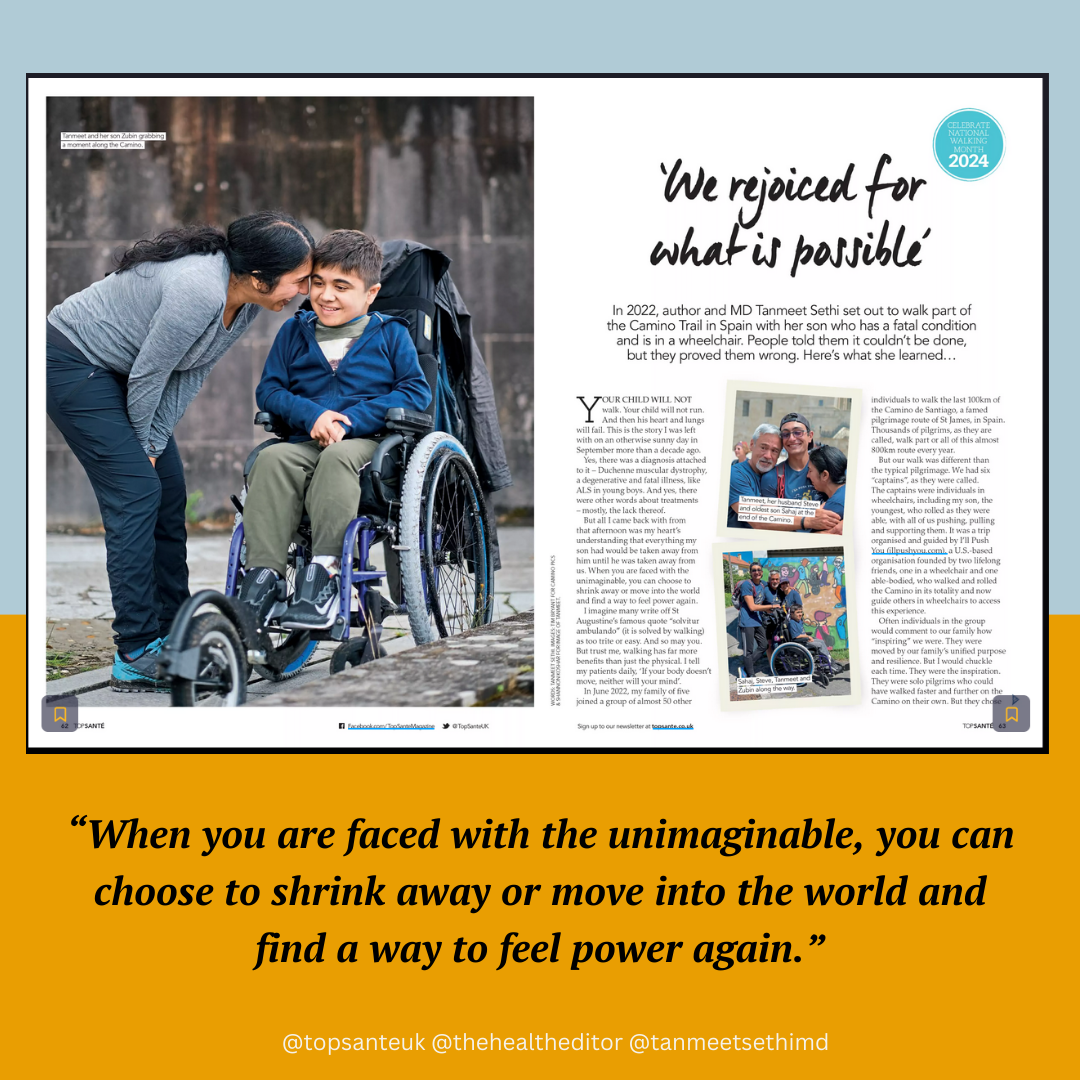
Top Sante UK: 'We Rejoiced For What Is Possible'
-
![]()
Women's Fitness UK: Rowing Grew My Resilience
-
![]()
Women's Health: What Your Obsession With Taylor Swift's Relationships Says About You, According To Experts
-
![]()
If you’re planning a family gathering, this sage advice from Tanmeet Sethi will help you create a peaceful atmosphere this Christmas.
-
![]()
Mindbodygreen: Infrared Vs. Traditional Sauna: Which Is Better? Experts Weigh In
-
![]()
Happiful Magazine: Into the Unknown--Going Through Life's Transitions
-
![]()
Women.Com: We Asked Mental Health Experts What It Really Means to Practice Gratitude-Exclusive
-
![]()
First for Women: The Secret to A Happier Mood + Better Sleep Is a Regulated Nervous System — 7 Easy Ways to Get One!
-
![]()
Delish Magazine: Here’s What Actually Happens To Your Body When You Eat Spicy Food
-
![]()
Interview about Tanmeet's work with Culinary Medicine